




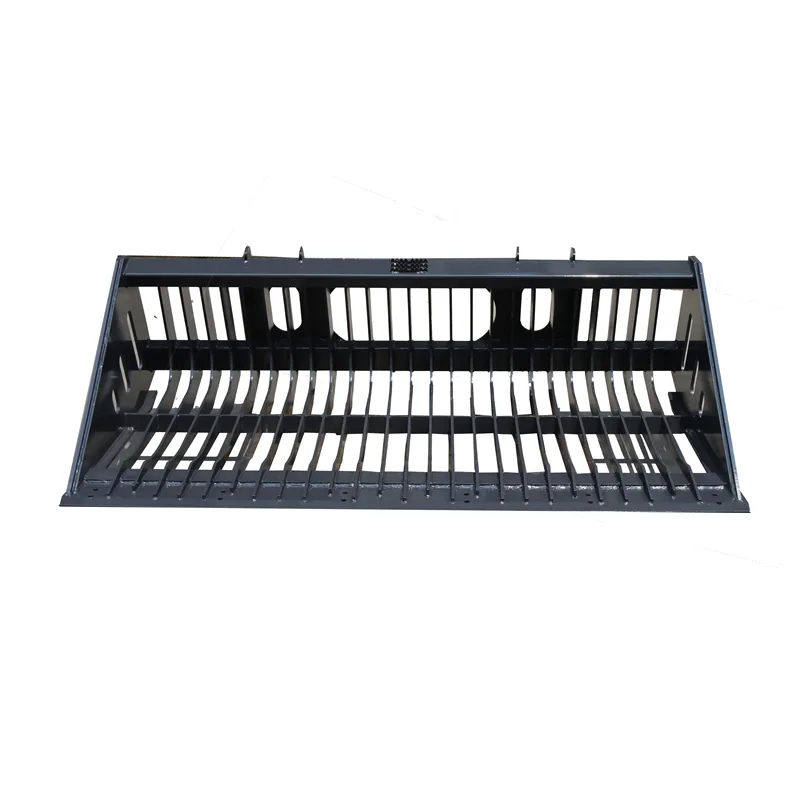
Removing rocks from soil is a very different job from simply moving loose material. A standard bucket can load dirt, gravel and general debris, but it does not separate unwanted rocks from usable soil. When a site contains stones, roots, vegetation, broken concrete or other coarse debris, repeatedly scooping and dumping material with a conventional bucket can create unnecessary handling work.
A rock bucket is designed for a different approach. Its open skeletal structure allows finer soil to fall through the spaces between the tines while larger rocks and unwanted debris remain in the bucket. This makes the attachment particularly useful when the goal is not only to move material, but also to separate and collect it.
HCN's 0101 Rock Bucket is designed around this principle. The attachment uses interconnected, gusseted tines to retain rocks and debris while allowing loose soil to pass through. HCN describes applications including jobsite cleanup, landscaping, farm-field rock removal and property maintenance. The design can also be used above ground to clear surface vegetation and debris or below ground to pull out submerged objects.
For contractors and equipment buyers, however, choosing a rock bucket is not simply a matter of selecting the widest attachment available. The machine, working environment, tine spacing, material size and desired production method all influence which configuration makes sense.
What Is a Rock Bucket Used For?
A rock bucket is a screening-style attachment used to collect larger objects while allowing smaller loose material to pass through the bucket structure. This makes it particularly useful in applications where the operator needs to clean an area without removing all of the surrounding soil.
Common applications include:
-
Removing rocks from construction sites
-
Clearing stones from agricultural fields
-
Preparing land before landscaping work
-
Cleaning up demolition and construction debris
-
Removing surface vegetation and coarse debris
-
Pulling larger objects from loose soil
-
Preparing ground for grading or subsequent construction work
-
General property and acreage maintenance
The major advantage is selective handling. Instead of filling the bucket with soil, transporting the entire load and then separating the unwanted material somewhere else, the operator can use the spacing between the tines to screen material during the loading process.
Why Use a Rock Bucket Instead of a Standard Bucket?
A standard bucket is primarily designed to carry and move material. A rock bucket adds a separation function.
Imagine a contractor preparing a rough piece of land for landscaping. The surface contains loose soil mixed with rocks and vegetation. With a conventional bucket, the operator may collect soil and rocks together. After dumping the load, additional sorting or handling may be required.
A rock bucket approaches the task differently. As the attachment is lifted, smaller soil particles can fall through the open tine structure while larger rocks remain inside. The operator can then transport the unwanted material separately.
This distinction becomes important when the objective is site preparation rather than simple excavation. The attachment can help reduce unnecessary movement of material and give the operator better control over what is being removed from the work area.
Rock Bucket vs. General-Purpose Bucket
A general-purpose bucket is normally the better choice when the main requirement is loading, carrying and dumping material. It provides a closed bucket profile that is suitable for bulk material handling.
A rock bucket is more appropriate when separation is part of the job. The open structure is specifically useful when rocks or debris need to be retained while finer material passes through.
The decision should therefore be based on the work objective rather than simply bucket capacity. If the site requires material separation, a rock bucket can offer a more suitable working method than a conventional bucket.
How Tine Spacing Affects Rock Bucket Performance
Tine spacing is one of the most important considerations when selecting a rock bucket.
The basic principle is straightforward: the spacing determines which material is likely to remain in the bucket and which material can fall through. Smaller spacing is generally more suitable when the operator needs to retain smaller rocks or coarse debris. Wider spacing allows more material to pass through and can be useful when the main targets are larger rocks and oversized objects.
HCN's 0101 Rock Bucket range includes models with different tine spacing configurations. The listed models include 94 mm spacing on the Mini versions and 62 mm spacing on the larger models shown on the product page. Because the actual material size and operating conditions vary from one job to another, buyers should compare the required separation size with the attachment configuration before ordering.
Questions to Ask About Tine Spacing
-
What is the smallest rock that needs to be removed?
-
Should smaller stones remain in the bucket or fall through?
-
Is the material mostly soil and rocks, or does it contain branches and vegetation?
-
Will the attachment be used for surface cleanup or deeper material removal?
-
Does the site contain irregular or oversized debris?
There is no universal tine spacing that is ideal for every job. The correct configuration depends on what the operator considers waste and what material should remain on the ground.
Choosing the Right Rock Bucket Width
Attachment width should be matched to the carrier machine and the working environment rather than selected solely for maximum coverage.
A wider bucket can cover more ground during each pass, but greater width also means greater attachment size and potentially more weight. In confined construction sites, landscaping projects or areas between existing structures, excessive width can reduce maneuverability.
HCN's 0101 Rock Bucket page lists several models ranging from compact versions to wider configurations. The listed overall widths include approximately 1,015 mm, 1,245 mm, 1,580 mm, 1,890 mm and 2,190 mm, depending on model.
For a contractor choosing between different sizes, the most useful approach is to consider the machine's rated operating capacity, the available working space and the type of material being handled. A bucket that is too large for the carrier may reduce practical productivity even if it covers more ground per pass.
Rock Bucket Selection for Skid Steer Loaders
Skid steer loaders are commonly used for land clearing, landscaping, site preparation and material handling because they can switch between attachments quickly. When selecting a rock bucket for a skid steer, the attachment should be evaluated as part of the complete machine-and-attachment combination.
Important considerations include:
1. Loader Capacity
The carrier must be capable of safely handling the attachment and the material being collected. Rocks can be significantly heavier than their apparent volume suggests, so an attachment that looks manageable when empty can become substantially heavier during operation.
2. Attachment Weight
Attachment weight affects the machine's balance, lift capacity and transport characteristics. HCN lists rock bucket weights from approximately 80 kg for the smallest listed model to around 330 kg for one of the larger models on its product page.
3. Working Width
The attachment should provide enough coverage for efficient passes without creating unnecessary restrictions in narrow working areas.
4. Material Type
Rock size, soil condition, vegetation and debris composition should all be considered before selecting the attachment configuration.
5. Visibility
HCN's skeletal rock bucket design is intended to keep the bucket tip visible to the operator. Visibility becomes particularly useful when the attachment is being positioned around rocks, roots, structures or uneven terrain.
When a Rock Bucket Is Better Than a Grapple Bucket
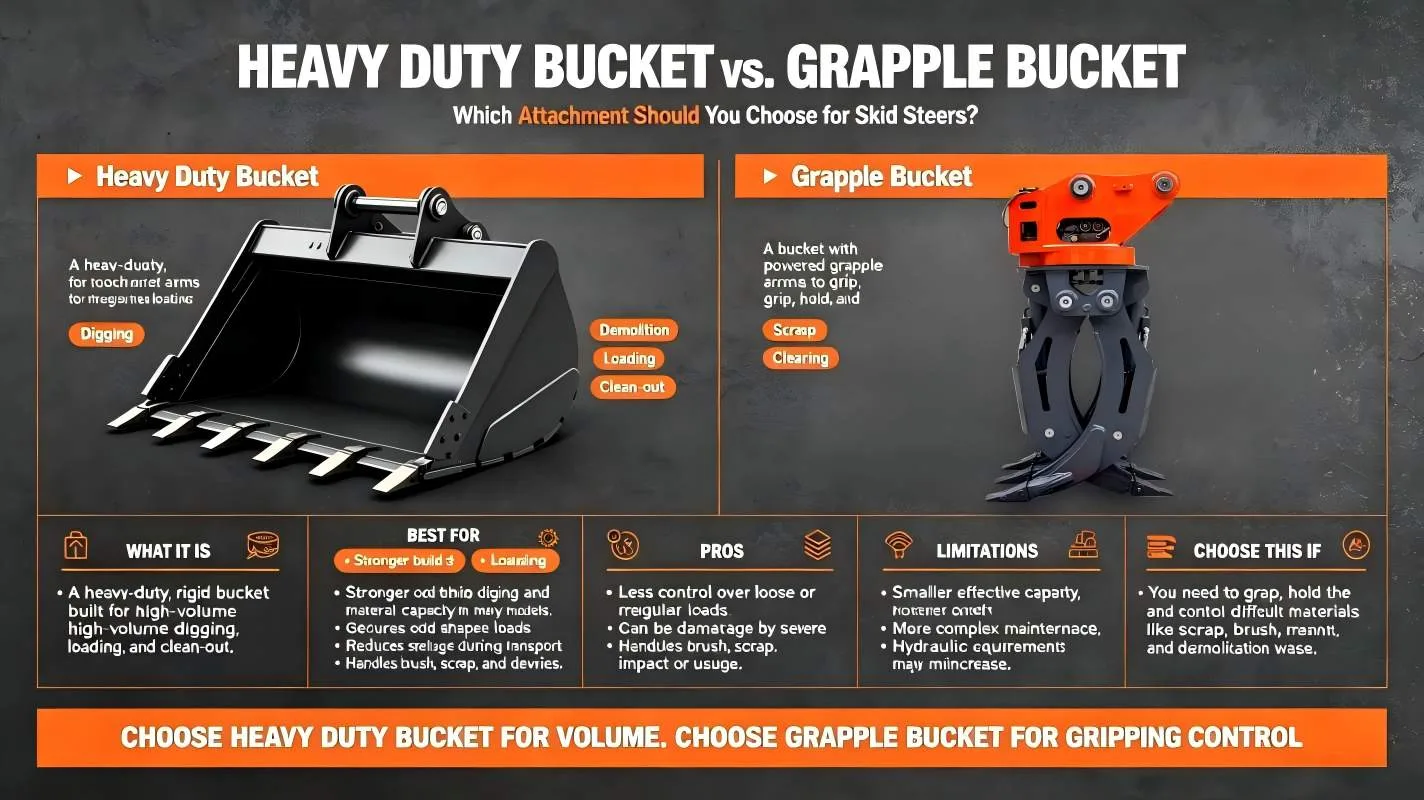
Rock buckets and grapple buckets can both be used for land clearing, but their operating principles are different.
A grapple bucket is especially useful when the operator needs to clamp, hold and transport irregular materials. Branches, logs, bulky debris and uneven loads are examples where gripping action can be valuable.
A rock bucket, on the other hand, is more focused on separating rocks and debris from loose soil. Its open tine structure provides the screening effect without relying on hydraulic grapple arms.
HCN also offers a 0403 Series Heavy Duty Grapple Bucket. Its product information describes applications involving bulky and difficult-to-handle materials, with grapple configurations designed to secure loads. This makes it a useful alternative when the primary challenge is gripping and transporting irregular material rather than screening soil.
The choice can therefore be summarized simply:
-
Choose a rock bucket when separation of rocks and debris from soil is the main objective.
-
Choose a grapple bucket when gripping and securing irregular loads is more important.
-
Choose a conventional bucket when bulk loading, carrying and dumping are the main tasks.
-
Consider a four-in-one bucket when one attachment needs to perform several different material-handling and grading functions.
Rock Removal During Land Clearing
Land clearing often involves more than removing trees or brush. Once vegetation has been cleared, rocks, roots and other buried or surface debris can remain in the working area.
This is where a rock bucket can become useful during the transition from rough clearing to site preparation.
The operator can position the bucket near the surface, engage the material and lift. As loose soil falls through the tines, larger objects remain in the attachment. The collected material can then be moved to a designated disposal or stockpile area.
Because the bucket can work above ground as well as below ground, the attachment can also be used for pulling objects from loose soil. However, operators should always account for buried utilities, structures and other hazards before penetrating the ground.
Using a Rock Bucket for Farm Field Cleanup
Rock removal is a common preparation task where agricultural land contains stones that interfere with cultivation, landscaping or other ground work.
A rock bucket can help collect stones while allowing finer soil to remain in the working area. This can be more efficient than transporting large quantities of soil simply to remove a relatively small amount of rock.
The appropriate attachment size depends on the carrier and field conditions. In open agricultural areas, a wider configuration may cover more ground per pass. In smaller plots, around buildings or near existing landscaping, a more compact attachment can provide better control.
Using a Rock Bucket for Construction Site Cleanup
Construction sites can contain mixed material such as stones, chunks of concrete, vegetation, soil and miscellaneous debris. The rock bucket is most useful when the operator needs to separate coarse material from loose soil rather than simply move the entire mixture.
Before using the attachment, the operator should determine what material can safely be handled and whether the debris contains objects that could damage the attachment or create a hazard.
The open structure also provides a practical advantage when the operator needs visibility into the attachment during loading. This can help when positioning around larger rocks or working close to finished surfaces.
Operating Technique Matters
A rock bucket works differently from a conventional digging bucket. The objective is not necessarily to fill the bucket as quickly as possible. Instead, the operator should allow the tine structure to perform the separation process.
A practical operating sequence is:
-
Approach the material at a controlled speed.
-
Position the bucket so the tines engage the target rocks and debris.
-
Lift the attachment while allowing loose material to pass through the tine openings.
-
Keep the collected debris contained during transport.
-
Dump the unwanted material at the designated location.
-
Repeat the process while monitoring the material remaining on the ground.
Trying to force excessive material into the attachment can reduce the effectiveness of the separation process. In difficult ground, controlled passes can be more useful than aggressive digging.
Common Rock Bucket Selection Mistakes
Choosing Only by Width
A wider attachment is not automatically the most productive choice. Machine capacity, operating space and attachment weight all matter.
Ignoring Tine Spacing
If the spacing does not match the target rock size, the attachment may either retain too much material or allow unwanted rocks to pass through.
Using a Rock Bucket for Every Material-Handling Job
A rock bucket is specialized for screening and collection. It should not automatically replace a general-purpose bucket or grapple attachment when those tools are better suited to the task.
Overloading the Attachment
Large rocks can become heavy very quickly. Operators should work within the carrier manufacturer's operating limits and consider the combined weight of the attachment and load.
Failing to Inspect the Tines
The tines are the working structure responsible for retaining material and allowing soil to pass through. Bent, damaged or excessively worn components can affect performance.
Maintenance Considerations for Rock Buckets
Maintenance requirements are relatively straightforward, but regular inspection is important for attachments working in abrasive environments.
Before and after operation, inspect the attachment for bent tines, cracked welds, loose hardware and abnormal wear. Pay particular attention to the areas that experience repeated contact with rocks and hard ground.
Cleaning the attachment after use can also make inspection easier. Soil and debris trapped around structural components can hide wear or damage.
If replaceable components are fitted, follow the manufacturer's maintenance and replacement recommendations. Any hydraulic or mounting components should also be checked according to the carrier and attachment manufacturer's instructions.
How HCN's 0101 Rock Bucket Fits Different Applications
HCN's 0101 Rock Bucket is available in several configurations. The product page lists compact models as well as wider versions, giving equipment buyers options for different carrier sizes and working environments.
The attachment uses a skeletal structure and gusseted tines designed for strength in demanding conditions. HCN specifically identifies applications including jobsite cleanup, landscaping, farm-field rock removal and property maintenance.
The published specifications provide useful reference points for purchasing decisions. For example, the listed overall widths range from approximately 1,015 mm to 2,190 mm, while the listed weights range from approximately 80 kg to 330 kg depending on model.
These figures should be evaluated together with the carrier manufacturer's rated capacity and the actual operating conditions. Buyers should confirm compatibility before ordering rather than selecting an attachment based only on dimensions.
What to Check Before Buying a Rock Bucket
A professional purchasing process should begin with the job rather than the attachment model.
Before requesting a quotation, prepare the following information:
-
Carrier machine type
-
Carrier operating capacity
-
Typical rock size
-
Desired tine spacing
-
Required working width
-
Typical soil condition
-
Whether vegetation or roots are present
-
Whether the work is primarily surface cleanup or ground engagement
-
Expected transport and dumping requirements
-
Available attachment mounting configuration
Providing this information to an attachment supplier makes it easier to identify a practical configuration and avoid purchasing an attachment that is either too small for the job or too heavy for the carrier.
Rock Bucket Buying Guide: A Simple Decision Process
For buyers comparing different rock bucket attachments, the selection process can be simplified into five questions.
Question 1: What Are You Removing?
If the primary targets are rocks and coarse debris mixed with soil, a rock bucket is a logical option. If the material consists mainly of logs, branches or bulky objects, a grapple may be more appropriate.
Question 2: What Should Stay on the Ground?
This determines the importance of tine spacing. The attachment should retain the unwanted objects while allowing acceptable soil or smaller material to pass through.
Question 3: What Machine Will Carry It?
Confirm attachment weight, width, mounting compatibility and carrier capacity before selecting a model.
Question 4: Where Will It Work?
Open fields can accommodate wider attachments, while residential landscaping and confined construction areas may favor more compact configurations.
Question 5: What Happens After Collection?
Consider where rocks and debris will be dumped or stockpiled. Efficient attachment selection is only part of the workflow; loading, transport and disposal should also be considered.
Final Takeaway
The right rock bucket is determined by the material, machine and job—not simply by attachment size. For contractors and equipment buyers, the most important factors are tine spacing, working width, attachment weight, carrier compatibility, visibility and the type of material being removed.
A rock bucket becomes especially valuable when the objective is to separate rocks and coarse debris from usable soil. Instead of treating the entire load as waste, the operator can use the open tine structure to retain larger objects while allowing finer material to fall through.
HCN's 0101 Rock Bucket is built around this working principle and is offered in multiple configurations for different operating requirements. For land clearing, landscaping, farm-field cleanup and construction-site preparation, selecting the correct configuration can make the difference between simply moving material and efficiently separating it.
For buyers evaluating a rock bucket, the best starting point is the actual job: identify the material to remove, determine the desired separation size, check the carrier's capacity and then select the attachment dimensions that match the working environment.
Frequently Asked Questions
1. What is a rock bucket used for?
A rock bucket is used to collect rocks, stones and coarse debris while allowing finer soil to pass through the open tine structure. Typical applications include land clearing, landscaping, farm-field cleanup, construction-site preparation and property maintenance.
2. Is a rock bucket better than a standard bucket for removing rocks?
For separating rocks from soil, a rock bucket is generally more suitable because its open tine structure allows finer material to fall through. A standard bucket is better suited to conventional loading, carrying and dumping.
3. How do I choose rock bucket tine spacing?
Base tine spacing on the size of the rocks and debris that need to remain in the bucket. Smaller spacing can retain smaller objects, while wider spacing allows more material to pass through. The actual material size and desired separation should guide the decision.
4. Can a rock bucket be used for land clearing?
Yes. Rock buckets can be useful after vegetation has been cleared, particularly when the site still contains rocks, surface debris or coarse material mixed with soil.
5. Can a rock bucket be used with a skid steer loader?
HCN offers rock bucket configurations intended for loader applications. Before purchasing, the attachment dimensions, weight, mounting system and carrier capacity should be checked against the specific machine.
6. What is the difference between a rock bucket and a grapple bucket?
A rock bucket is primarily designed to separate and collect rocks and coarse debris from soil. A grapple bucket is designed to grip and secure irregular or bulky materials such as branches, debris and other uneven loads.
7. Does a wider rock bucket always increase productivity?
Not necessarily. A wider bucket can cover more ground per pass, but it also increases attachment size and may affect maneuverability and machine loading. The best width depends on the carrier and working environment.
8. What should I provide when asking for a rock bucket quotation?
Provide the carrier machine type, operating capacity, desired working width, typical material size, required tine spacing and primary application. This information helps the supplier recommend a configuration that matches the actual job.
Internal Link Suggestions
-
0101 Rock Bucket — Use this as the primary product link after explaining rock bucket selection and applications.
-
Heavy Duty Grapple Bucket — Add this when comparing rock buckets with grapple-based material handling.
-
Heavy Duty Four In One Bucket — Add this when discussing multifunctional bucket alternatives.
-
0103 Series Heavy Duty Bucket — Link when explaining the difference between a screening bucket and a conventional heavy-duty bucket.
-
Heavy Duty Pallet Fork — Link from the broader material-handling discussion as an alternative attachment for palletized and bulky loads.
Image Suggestions
-
Image Description: A skid steer loader using a rock bucket to separate rocks from loose soil on a construction site.
Recommended File Name: skid-steer-rock-bucket-land-clearing.jpg
ALT Text: Skid steer rock bucket separating rocks from soil during land clearing
Recommended Placement: After the introduction. -
Image Description: Close-up view of rock bucket tines with rocks retained inside and finer soil falling through the openings.
Recommended File Name: rock-bucket-tine-spacing.jpg
ALT Text: Rock bucket tines separating stones and loose soil
Recommended Placement: In the section discussing tine spacing. -
Image Description: Wheel loader or skid steer clearing rocks from a large agricultural field.
Recommended File Name: rock-bucket-farm-field-cleanup.jpg
ALT Text: Rock bucket attachment removing stones from a farm field
Recommended Placement: In the agricultural application section. -
Image Description: Side-by-side visual concept showing a rock bucket and grapple bucket performing different material-handling tasks.
Recommended File Name: rock-bucket-vs-grapple-bucket.jpg
ALT Text: Comparison of rock bucket and grapple bucket applications
Recommended Placement: After the rock bucket versus grapple bucket section. -
Image Description: HCN rock bucket attachment working on a rough construction site with rocks and debris.
Recommended File Name: hcn-rock-bucket-construction-site.jpg
ALT Text: HCN rock bucket used for construction site debris removal
Recommended Placement: Before the final takeaway.
 +86 185 5285 3111
 +86 185 5285 3111
 nancy@hcn-tech.com
