




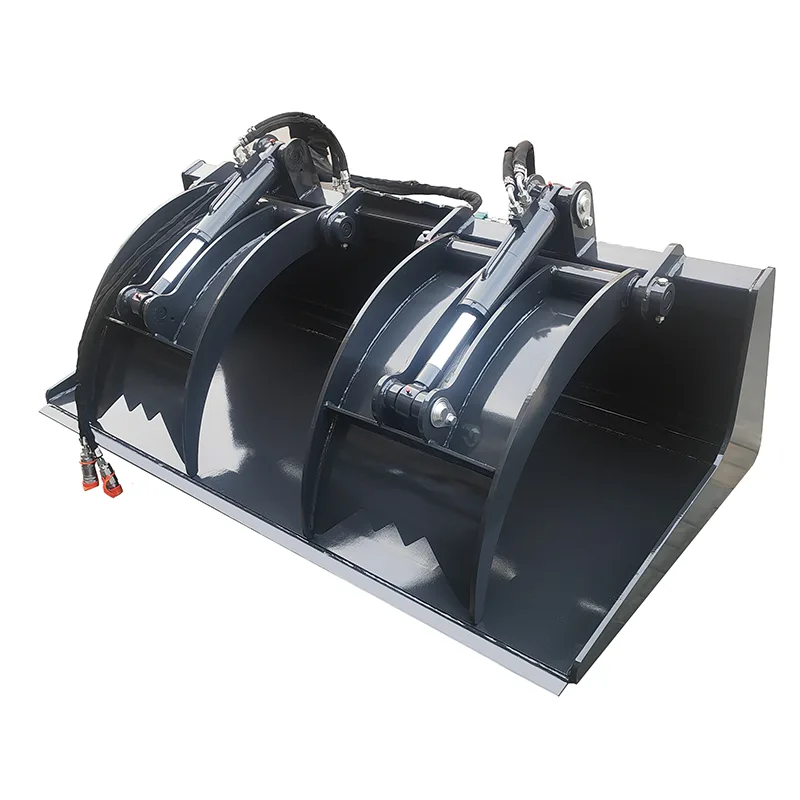
How to Choose a Grapple Bucket for a Skid Steer: Applications, Capacity and Buying Considerations
A grapple bucket can turn a skid steer loader into a more capable material-handling machine for jobs that involve irregular, bulky, loose, or difficult-to-control materials. Unlike a conventional bucket, a grapple bucket uses a hydraulic clamping mechanism to secure material during lifting, carrying, loading, and sorting.
That difference matters on jobs involving brush, logs, construction debris, rocks, scrap materials, agricultural waste, and other loads that are difficult to contain with a standard bucket. The right grapple bucket can also reduce repeated repositioning because the operator can grip material rather than relying only on the bucket cutting edge.
HCN offers the 0403 Series Heavy Duty Grapple Bucket, designed for skid steer loaders and small wheel loaders. The product range includes multiple sizes and a dual-cylinder grapple configuration for handling bulky and difficult materials.
However, choosing a grapple bucket should not begin with bucket width alone. Hydraulic compatibility, machine capacity, material type, grapple opening, attachment weight, and the way the bucket will be used all affect the final choice.
What Is a Skid Steer Grapple Bucket?
A skid steer grapple bucket combines the basic loading function of a bucket with a hydraulic grapple mechanism. The bucket provides a base for carrying material, while the upper grapple applies clamping force to hold objects securely.
This design is particularly useful when the material does not naturally form a stable load. Soil and gravel can normally be contained by a conventional bucket, but branches, demolition debris, logs, uneven rocks, scrap materials, and bulky vegetation may extend beyond the bucket profile.
With a grapple, the operator can close the upper arms around the material before lifting. This makes it possible to move irregular loads with greater control.
The HCN 0403 Series Heavy Duty Grapple Bucket uses a two-arm design on larger industrial grapple configurations and dual hydraulic cylinders to provide clamping force. HCN lists the attachment for skid steer loaders and small wheel loaders.
Why Use a Grapple Bucket Instead of a Standard Bucket?
A conventional bucket is highly effective for loose material, but it has limitations when the load is long, oversized, uneven, or difficult to contain.
Consider a brush-clearing project. A standard bucket may be able to push branches into a pile, but lifting that pile can cause material to fall from both sides. The operator may need to make several passes before the load is stable enough to transport.
A grapple bucket approaches the same task differently. The operator can position the bucket beneath the material, close the grapple, and secure the load before lifting.
This difference becomes especially useful in applications such as:
Brush and vegetation cleanup
Log and timber handling
Construction debris removal
Rock and irregular material handling
Scrap material handling
Farm and agricultural material handling
Land clearing
Storm debris cleanup
Site preparation
General property maintenance
The objective is not simply to replace a standard bucket. A grapple bucket provides an additional material-control function when the conventional bucket design is not enough.
Match the Grapple Bucket to the Material You Handle
The first practical question when selecting a grapple bucket is not “How wide should it be?” but “What material will I handle most often?”
Brush and Vegetation
Brush is one of the most common applications for grapple buckets. Branches and vegetation are lightweight relative to their volume, which means a large pile can occupy considerable space without necessarily reaching the machine's maximum lifting capacity.
A grapple helps compress and retain the material during transport. For landscaping and land-clearing contractors, this can make cleanup operations more manageable.
Logs and Timber
Logs create a different challenge because of their length and cylindrical shape. A conventional bucket may allow a log to roll or extend beyond the sides. A grapple can clamp the material and keep it positioned during lifting.
Operators should still remain within the rated lifting capability and stability limits of the host machine. The attachment does not increase the fundamental lifting capacity of the skid steer.
Construction Debris
Construction and demolition sites frequently contain materials with inconsistent shapes. Broken concrete, timber, metal, insulation, packaging, and other debris may be difficult to handle with a conventional bucket.
A grapple bucket can be useful when the job requires picking individual pieces or securing a mixed load before moving it.
Rocks and Irregular Materials
Rocks can roll or shift when transported in a conventional bucket. A grapple provides an additional point of control and can be useful for picking individual rocks, moving large irregular pieces, or clearing a site.
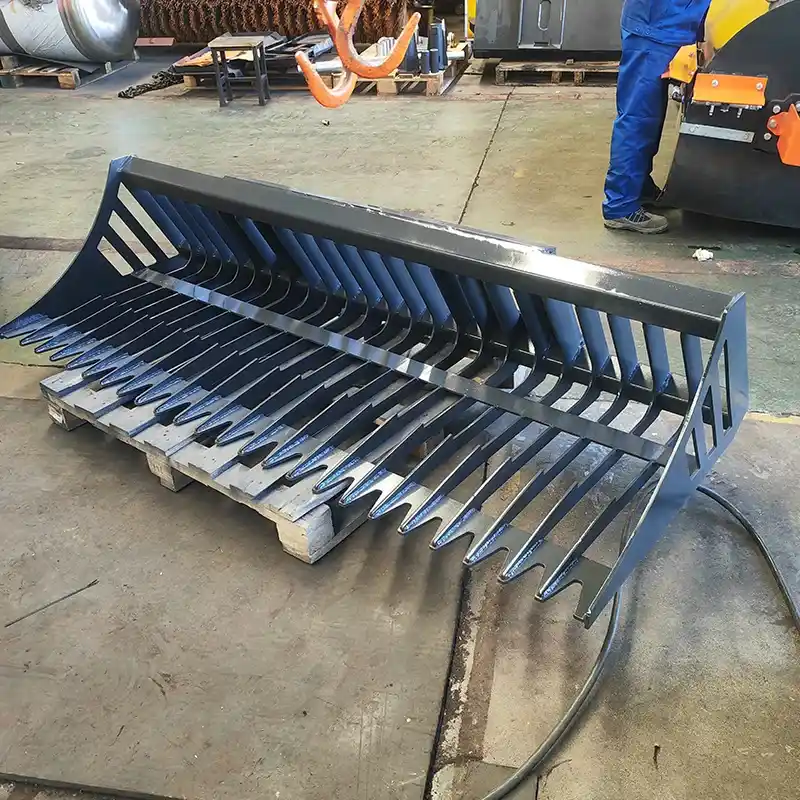
For applications focused primarily on rock separation rather than clamping, a dedicated rock or skeleton-style attachment may be more appropriate. HCN also lists rock-handling attachments within its product range, so buyers should compare the actual task before selecting the attachment.
Hydraulic Flow Matters More Than Many Buyers Expect
A grapple bucket is a hydraulic attachment, so hydraulic compatibility should be checked before purchase.
The HCN 0403 Series Heavy Duty Grapple Bucket lists a working hydraulic flow range of 20–30 L/min and a working pressure of 21 MPa for the listed models. The product page identifies 040360, 040372, and 040384 configurations, with weights ranging from 320 kg to 580 kg.
These published specifications should be compared with the actual hydraulic specifications of the skid steer or small wheel loader being used.
Do not assume that a universal quick-attach interface automatically means complete hydraulic compatibility. The attachment connection, hydraulic couplers, flow requirements, operating pressure, electrical controls where applicable, and hose routing should all be confirmed before operation.
How Attachment Weight Affects Skid Steer Performance
Attachment weight is an important part of grapple bucket selection because the attachment itself becomes part of the machine's working load.
A heavier grapple may offer a more substantial structure, but additional attachment weight can reduce the amount of payload available for the material being carried.
For example, the HCN 0403 Series lists three main configurations with weights of approximately 320 kg, 510 kg, and 580 kg. The difference is significant when the attachment is mounted on a compact machine with limited operating capacity.
Buyers should therefore consider:
Rated operating capacity of the skid steer
Rated operating capacity of the wheel loader if applicable
Attachment weight
Typical material density
Load center and material position
Terrain and ground conditions
Required lifting height
Frequency of loading and carrying
A larger attachment is not automatically more productive if the host machine cannot use it effectively.
Grapple Opening and Material Size
The opening of the grapple affects what the attachment can physically capture.
For brush, branches, logs, and bulky waste, the grapple must open far enough to surround the material. If the opening is too small, the operator may spend more time repositioning the load.
The HCN 0403 Series lists grapple distances of approximately 790 mm to 1,000 mm depending on model. This provides useful reference information when comparing attachment size with the materials encountered on a jobsite.
However, maximum grapple opening should not be considered in isolation. The bucket width, bucket depth, machine capacity, hydraulic performance, and overall attachment weight should all be evaluated together.
Bucket or Fork Bottom: Which Configuration Makes Sense?
One useful consideration when selecting a heavy-duty grapple is the type of lower structure used for the material-handling task.
A bucket-style bottom can be useful when the attachment needs to retain smaller pieces of material while loading and transporting. It provides a more enclosed loading surface than an open fork configuration.
A fork-style bottom can be advantageous when handling larger pieces while allowing smaller soil or loose material to fall through the gaps. This can be useful when the objective is to pick larger objects without carrying as much unwanted dirt.
HCN's 0403 Series Heavy Duty Grapple Bucket information identifies both bucket and fork-bottom configurations as options for different material-handling requirements.
The correct configuration therefore depends on whether the job is primarily about containment, picking, sorting, loading, or a combination of these tasks.
Common Applications for a Heavy-Duty Grapple Bucket
Land Clearing
During land clearing, the attachment can be used to gather brush, branches, logs, and other organic debris after cutting or mulching operations.
Construction Site Cleanup
On construction sites, a grapple bucket can help collect timber, broken materials, scrap, and other debris that may be difficult to contain with a standard bucket.
Roadside and Property Maintenance
Maintenance crews may encounter fallen branches, loose vegetation, rocks, and miscellaneous debris. A grapple provides a practical way to pick and transport irregular materials without changing to a specialized machine.
Agricultural Work
Grapple buckets can also be useful for moving bulky agricultural materials such as brush, vegetation, hay-related debris, or other irregular loads, depending on the attachment configuration and machine capacity.
Material Sorting
Because the grapple can hold individual objects, it can be useful where the operator needs to separate larger items from loose material or reposition specific pieces within a pile.
How to Select the Right Grapple Bucket Size
Choosing a grapple bucket size should start with the host machine rather than the attachment's maximum dimensions.
A practical selection process is:
Identify the skid steer or wheel loader model.
Check the machine's rated operating capacity.
Confirm the hydraulic flow and pressure available to the attachment.
Estimate the typical weight and dimensions of the material.
Compare attachment weight with available machine capacity.
Determine whether bucket or fork-style loading is more appropriate.
Check the required grapple opening.
Consider transportation width and jobsite access.
Confirm the quick-attach and hydraulic connection requirements.
This approach is more reliable than selecting an attachment solely because its width appears suitable.
Buying Considerations for Contractors and Equipment Dealers
Contractors should evaluate how frequently the grapple will be used and whether one configuration can cover multiple jobs.
If the attachment will be used primarily for brush and land clearing, retention and grapple opening may be particularly important. If the same machine will handle rocks and construction debris, structural strength and the lower bucket configuration become more important.
Equipment dealers and rental companies should also consider versatility. A grapple that can serve multiple customer applications may have broader utility than an attachment designed for only one material.
Before purchasing, buyers should request confirmation of:
Recommended host machine size
Hydraulic flow requirements
Operating pressure
Attachment weight
Overall dimensions
Grapple opening
Available bucket or fork configurations
Hydraulic hose and coupler requirements
Replacement components and service support
Operating Practices That Help Protect the Attachment
A grapple bucket should be used primarily to secure and move material rather than as a substitute for aggressive digging equipment.
Avoid forcing the grapple into the ground unnecessarily. Excessive ground contact can increase wear on cutting edges, teeth, cylinders, pivot points, and other components.
When handling heavy objects, keep the load as close to the machine as practical and operate within the host machine's rated limits. Avoid carrying loads higher than necessary, especially on uneven terrain.
Operators should also inspect hydraulic hoses, fittings, grapple pivots, cylinder connections, cutting edges, and structural components regularly. Loose hardware or damaged hydraulic components should be addressed before the attachment returns to heavy-duty service.
Why a Grapple Bucket Can Be a Useful Multi-Purpose Attachment
The biggest advantage of a grapple bucket is not that it performs one task exceptionally well. Its value comes from combining loading and gripping functions in one attachment.
A contractor may use the same skid steer for brush cleanup in the morning, construction debris handling in the afternoon, and general material movement later in the week. A grapple bucket can support these different tasks without requiring a dedicated material-handling machine for every application.
For fleets where attachment versatility matters, this can make a skid steer more useful across different job types.
HCN Heavy-Duty Grapple Bucket for Skid Steer Loaders
HCN's 0403 Series Heavy Duty Grapple Bucket is designed for demanding material-handling applications involving bulky and difficult-to-manage materials.
The listed models include 040360, 040372, and 040384. Depending on configuration, the attachment has an overall width from approximately 1,524 mm to 2,135 mm, a grapple distance of approximately 790 mm to 1,000 mm, a working flow requirement of 20–30 L/min, and a working pressure of 21 MPa.
The attachment is designed for skid steer loaders and small wheel loaders, giving contractors and equipment operators another option for brush, debris, rocks, scrap, agricultural materials, and other irregular loads.
For buyers comparing grapple buckets, the most important step is to match the attachment to the machine and the actual material-handling task. Width, weight, hydraulic requirements, grapple opening, and lower configuration should be considered together rather than separately.
Final Buying Checklist
Before ordering a skid steer grapple bucket, use the following checklist:
Is the attachment compatible with the host machine?
Does the machine provide the required hydraulic flow?
Is the hydraulic pressure compatible?
Is the attachment weight appropriate for the machine?
Is the grapple opening suitable for the materials being handled?
Would a bucket bottom or fork bottom be more useful?
Is the attachment width suitable for the jobsite?
Will the grapple be used for brush, logs, rocks, debris, or mixed materials?
Are replacement and maintenance requirements understood?
Has the supplier confirmed the complete machine-to-attachment compatibility?
A well-matched grapple bucket can significantly expand the material-handling capability of a skid steer. The key is not simply buying the largest attachment available, but selecting a configuration that matches the machine's hydraulic system, rated capacity, operating environment, and the materials encountered most often.
For contractors, dealers, rental fleets, and other professional users, the HCN 0403 Series Heavy Duty Grapple Bucket provides a practical option for combining loading and gripping functions on skid steer loaders and small wheel loaders.
 +86 185 5285 3111
 +86 185 5285 3111
 nancy@hcn-tech.com
