




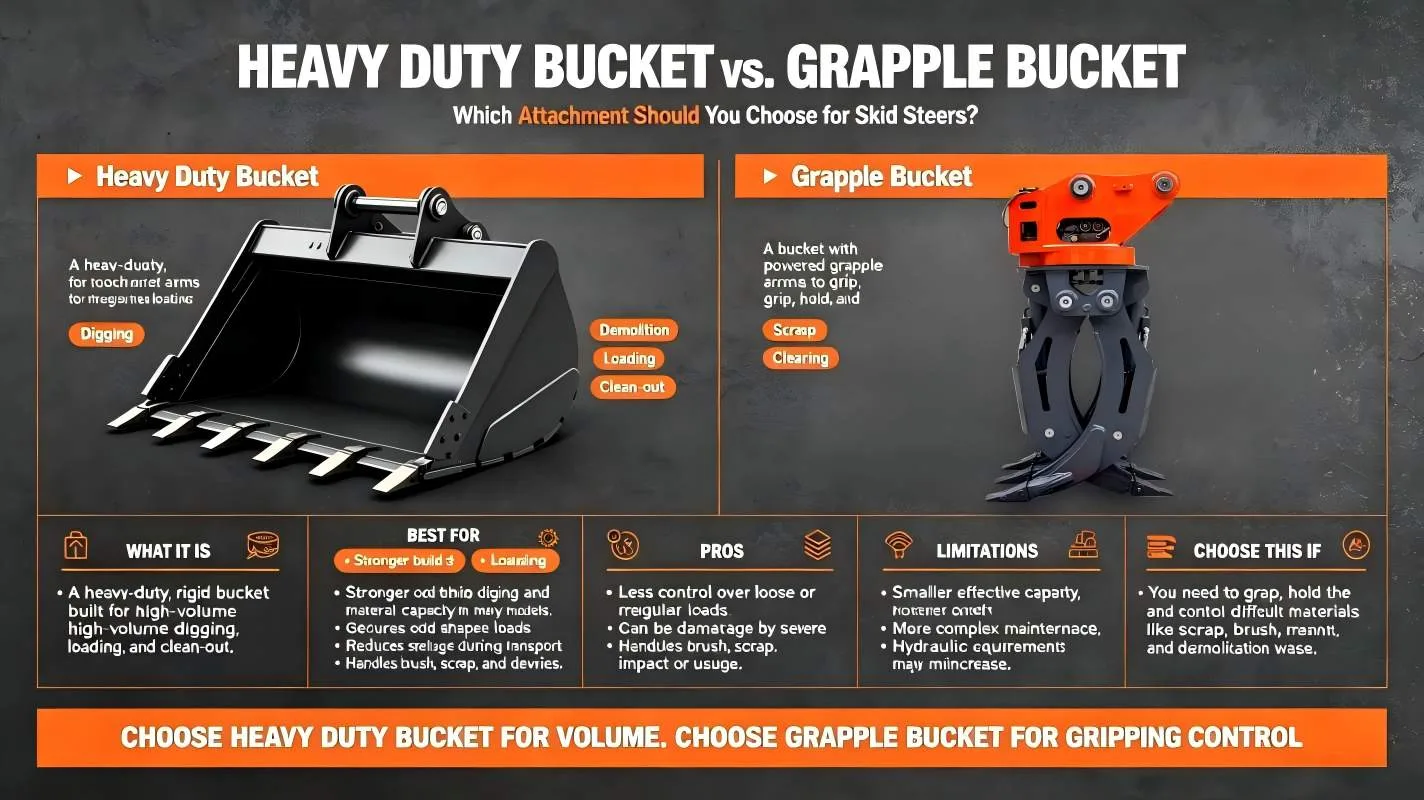
When a skid steer needs to move material, the attachment you choose can have a major effect on productivity, machine utilization, loading efficiency, and operating cost.
Two of the most common options are a heavy duty bucket and a grapple bucket. At first glance, both attachments can load, carry, and move material. In practice, however, they are designed for different handling tasks.
A heavy duty bucket is generally the more straightforward solution for loading loose and bulk material. A grapple bucket adds hydraulic clamping capability, allowing the operator to secure bulky, irregular, or difficult-to-contain materials.
For contractors, equipment dealers, rental fleets, landscapers, agricultural operators, and municipal fleets, the right choice should therefore be based on the material being handled rather than simply the attachment's size.
This guide compares HCN's current 0103 Series Heavy Duty Bucket with its 0403 Series Heavy Duty Grapple Bucket and explains when each type makes more sense.
Heavy Duty Bucket vs. Grapple Bucket: The Basic Difference
The most important difference is how the attachment controls the load.
A conventional heavy duty bucket uses its bucket body and cutting edge to scoop and retain material. It is particularly well suited to loose or relatively uniform materials that can be contained inside the bucket.
A grapple bucket adds a hydraulic grapple mechanism. Instead of relying entirely on the bucket's sidewalls and back, the grapple can clamp down on material.
This changes the type of work the skid steer can perform efficiently.
| Consideration | HCN 0103 Series Heavy Duty Bucket | HCN 0403 Series Heavy Duty Grapple Bucket |
|---|---|---|
| Primary function | Loading and carrying bulk material | Grabbing, loading and securing irregular material |
| Hydraulic function | No grapple-clamping circuit required for the basic bucket | Hydraulic grapple operation required |
| Best suited to | Loose and bulk materials | Bulky, irregular and difficult-to-contain materials |
| Typical applications | Construction, landscaping, agriculture, municipal work | Construction, demolition, recycling, salvage and material handling |
| HCN listed models | 010360, 010366, 010372, 010384 | 040360, 040372, 040384 |
| Listed working flow | Not specified on the current 0103 page | 20–30 L/min |
| Listed pressure | Not specified on the current 0103 page | 21 MPa |
The key point is simple: a grapple bucket is not automatically a better bucket. It is a different tool designed to solve a different material-handling problem.
When a Heavy Duty Bucket Is the Better Choice
A heavy duty bucket is often the better option when most of the work involves scooping, loading, carrying, leveling, or placing loose material.
HCN's current 0103 Series Heavy Duty Bucket is designed around a reinforced bucket structure and includes features such as a high-carbon cutting edge, formed channel construction, a reinforced bottom, and a round-back design intended to support loading and clean-out.
The current HCN specification table lists four models:
| Model | Inside Bucket Width | Blade Width | Flat Loading Capacity | Weight |
|---|---|---|---|---|
| 010360 | 1530 mm | 1580 mm | 0.34 m³ | 205 kg |
| 010366 | 1680 mm | 1730 mm | 0.38 m³ | 213 kg |
| 010372 | 1830 mm | 1880 mm | 0.40 m³ | 218 kg |
| 010384 | 2130 mm | 2180 mm | 0.46 m³ | 225 kg |
These specifications show why buyers should select a specific model rather than treating the entire series as one attachment.
For example, the 010360 and 010384 differ substantially in working width and flat loading capacity. A wider bucket may improve coverage and loading productivity in an appropriate application, but the correct choice still depends on the carrier machine and the actual work environment.
Typical applications for a heavy duty bucket
A heavy duty bucket can be a practical choice for:
Loading soil and loose material
Moving aggregate
Landscaping work
General construction-site material handling
Municipal maintenance
Agricultural material handling
Loading and stockpiling bulk materials
The 0103 Series is listed by HCN for skid steer loaders, with applications including construction, landscaping, agriculture, municipal maintenance, forestry, and snow removal.
For buyers whose work is primarily based on loose material, the simpler bucket design may provide exactly what is required without adding the hydraulic grapple mechanism.
When a Grapple Bucket Makes More Sense
A grapple bucket becomes more useful when the material is difficult to contain inside a conventional bucket.
Think about brush, demolition debris, irregular construction material, scrap, bulky vegetation, or mixed loads.
A conventional bucket can scoop such material, but loose pieces can fall out when the operator raises or tilts the attachment.
A grapple provides another point of control.
HCN describes its 0403 Series Heavy Duty Grapple Bucket as an industrial grapple for handling bulky and difficult-to-manage materials. The design uses hydraulic cylinders to operate the grapple and is intended for applications including demolition rubble, building materials, recycling, salvage, and scrap handling.
The current 0403 Series specification table lists:
| Model | Overall Length | Overall Width | Height Closed | Grapple Distance | Weight | Flow | Pressure |
|---|---|---|---|---|---|---|---|
| 040360 | 960 mm | 1524 mm | 670 mm | 1000 mm | 320 kg | 20–30 L/min | 21 MPa |
| 040372 | 925 mm | 1848 mm | 705 mm | 790 mm | 510 kg | 20–30 L/min | 21 MPa |
| 040384 | 925 mm | 2135 mm | 705 mm | 790 mm | 580 kg | 20–30 L/min | 21 MPa |
The difference in weight is particularly important.
The 040360 is listed at 320 kg, while the 040384 is listed at 580 kg. That means the buyer should not evaluate the grapple only by its width or opening.
The carrier's rated operating capacity, hydraulic capability, mounting interface, and the actual material being handled all need to be considered.
Heavy Duty Bucket vs. Grapple Bucket for Construction
Construction contractors often use skid steers for several different material-handling tasks on the same project.
For clean bulk material such as soil, aggregate, or other loose material, a heavy duty bucket can be the more direct solution.
For demolition, cleanup, sorting, or handling irregular debris, a grapple can provide a significant operational advantage because the load can be clamped rather than simply scooped.
A useful purchasing question is:
Does the material naturally stay inside a bucket?
If the answer is yes, start by evaluating a heavy duty bucket.
If the material is irregular, oversized, tangled, or likely to fall out during transport, a grapple deserves closer consideration.
Heavy Duty Bucket vs. Grapple Bucket for Landscaping
Landscaping applications can involve both types of attachment.
A heavy duty bucket is useful for:
Soil movement
Loading aggregate
General site preparation
Backfilling
Moving bulk landscaping materials
A grapple is more useful when the work involves:
Brush
Branches
Landscape debris
Irregular materials
Cleanup and site clearing
This is one reason attachment selection should start with the job cycle, not simply the machine size.
A landscaping contractor who mostly moves soil may gain little from paying for grapple functionality.
A contractor who regularly switches between material loading and vegetation cleanup may benefit from the additional handling capability of a grapple.
Construction and Demolition: Why Grapple Control Matters
Demolition and recycling environments often contain materials with shapes that do not work well with a conventional bucket.
A grapple can clamp around pieces of material and help keep them secured while the operator lifts and moves them.
HCN's 0403 Series is specifically described for handling demolition rubble, building materials, recycling, salvage, and scrap.
The grapple's hydraulic cylinders are therefore not simply an additional feature. They are central to the attachment's intended application.
For this type of work, the procurement question should be less about whether a grapple costs more than a bucket and more about whether the additional control can improve the overall material-handling cycle.
What About Pallet Forks?
Neither a heavy duty bucket nor a grapple bucket is the ideal attachment for every material-handling application.
If the primary job is moving palletized or packaged materials, a pallet fork may be a more appropriate choice.
HCN's Heavy Duty Pallet Fork is designed for moving bulky, bagged, or palletized materials and is listed for applications including construction sites, industrial plants, landscaping, farms, fertilizer handling, and municipal projects.
This gives buyers a useful three-way decision:
| Material / Task | Attachment to Consider |
|---|---|
| Loose soil, aggregate and bulk material | Heavy Duty Bucket |
| Irregular, bulky or difficult-to-contain material | Grapple Bucket |
| Pallets, packaged goods and forkable loads | Pallet Fork |
The correct attachment is therefore determined by the material and handling method.
Hydraulic Requirements Should Be Checked Before Ordering
Hydraulic compatibility becomes especially important when moving from a conventional bucket to a powered grapple.
HCN's current 0403 Series Heavy Duty Grapple Bucket lists a working hydraulic flow of 20–30 L/min and working pressure of 21 MPa for the listed 040360, 040372, and 040384 models.
Do not assume that every HCN attachment has the same hydraulic requirement.
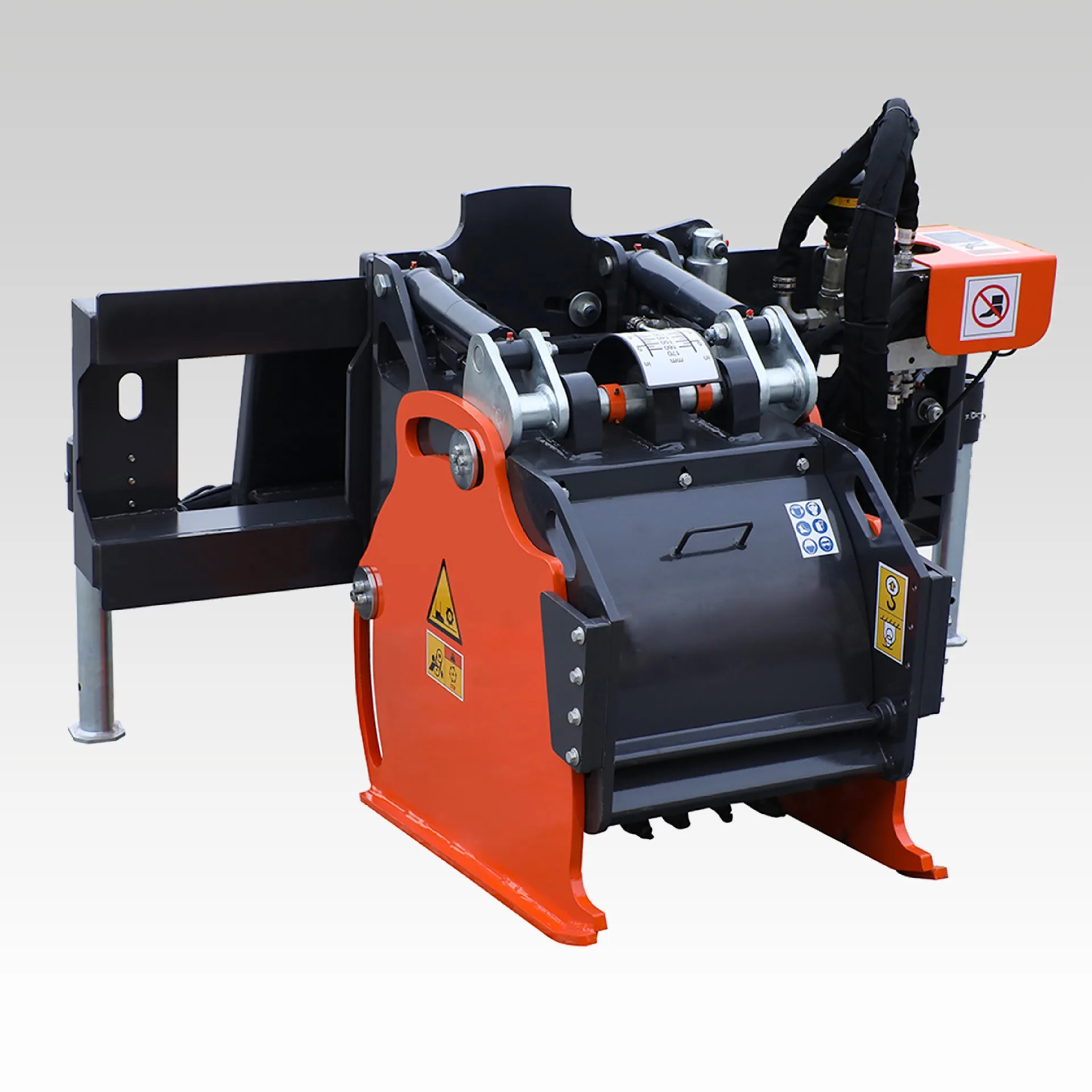
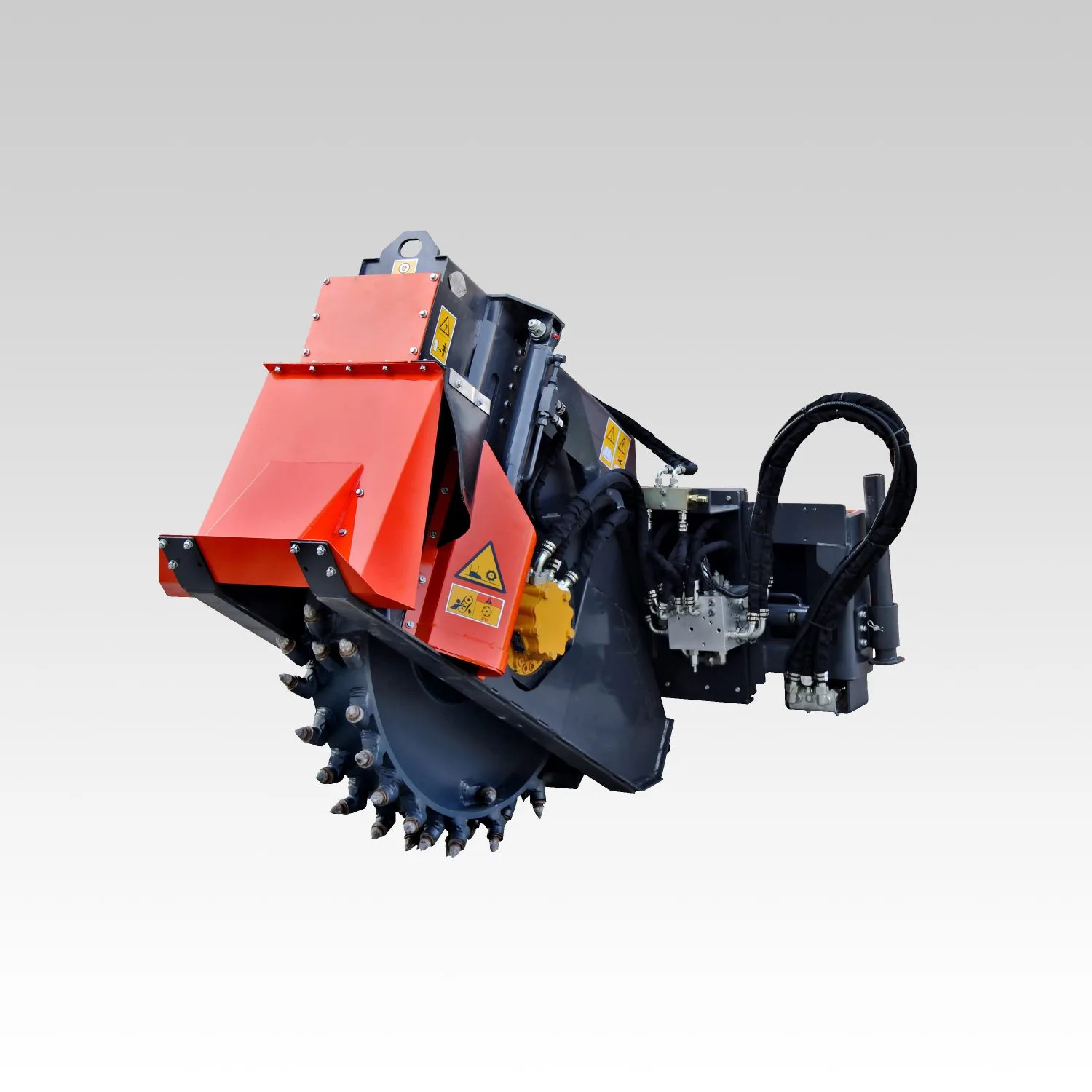
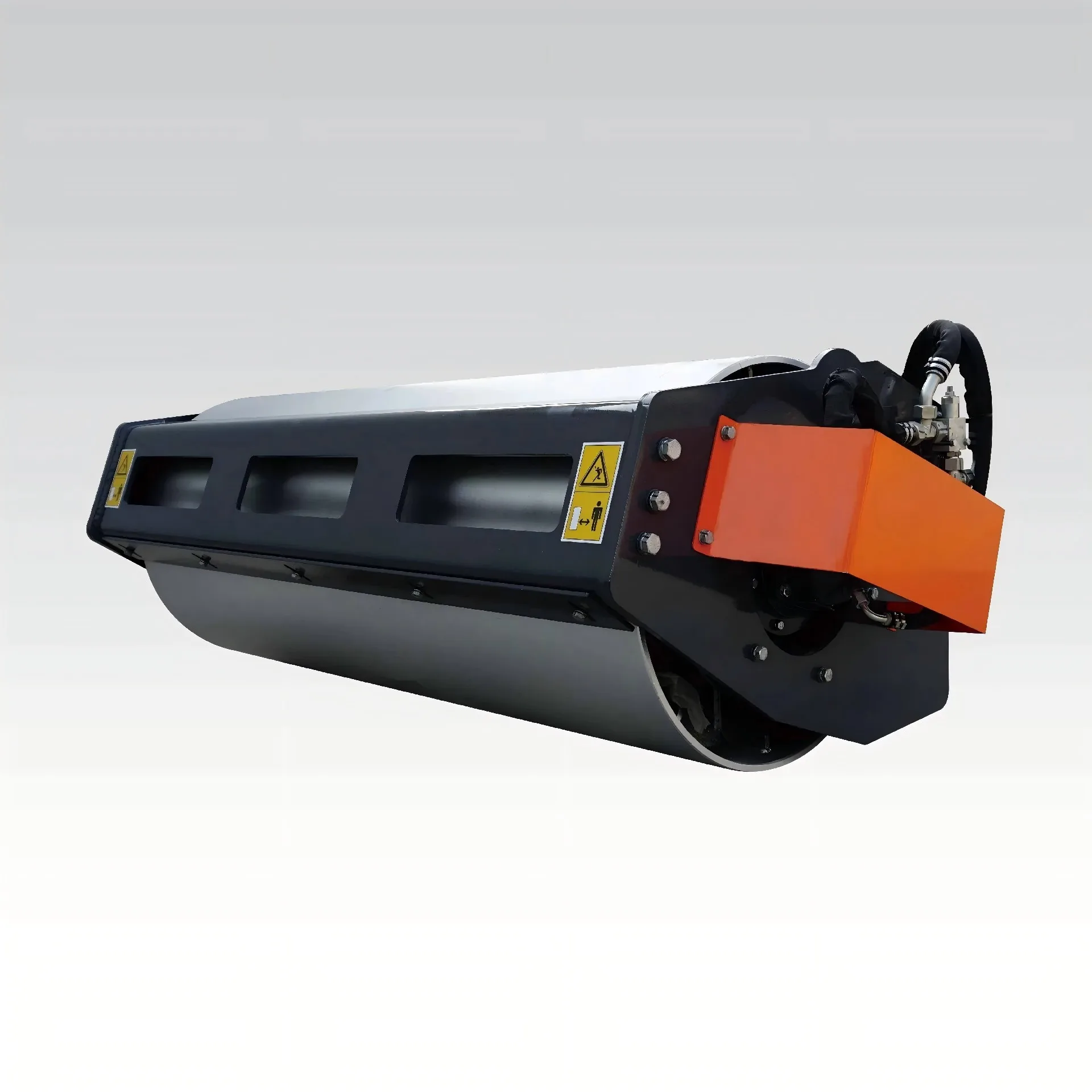
For example, HCN's 0206 Cold Planer models have substantially different hydraulic flow requirements depending on configuration, while the 0205 Vibratory Roller is listed at 60–70 L/min.
This is why attachment selection should always be based on the specific model, not merely the product category.
Before ordering a hydraulic attachment, confirm:
Machine brand and exact model
Auxiliary hydraulic flow
Hydraulic pressure
Operating capacity
Mounting interface
Electrical or control requirements where applicable
Attachment weight
Required working width
Intended application
Expected material and duty cycle
If the machine's hydraulic specification is unclear, obtain the information from the machine manufacturer or dealer rather than estimating it.
Attachment Weight Is an Important Part of the Decision
Attachment weight is easy to overlook when comparing buckets and grapples.
The HCN 0103 Series Heavy Duty Bucket ranges from 205 kg to 225 kg across the four listed models.
The 0403 Series Heavy Duty Grapple Bucket ranges from 320 kg to 580 kg across its three listed models.
That difference can affect the machine's overall operating behavior.
Before selecting the heavier attachment, verify the carrier manufacturer's rated operating capacity and approved attachment compatibility.
A skid steer may have sufficient hydraulic capacity for an attachment while still being unsuitable for the attachment because of operating capacity, stability, or other machine limitations.
How to Choose the Right Attachment for Your Fleet
For fleet managers and equipment dealers, the decision can be simplified into several questions.
Choose a Heavy Duty Bucket when:
Most loads are loose or bulk material
Scooping and loading are the primary tasks
You do not need hydraulic clamping
Low attachment complexity is preferred
The application involves frequent loading and stockpiling
Choose a Grapple Bucket when:
Loads are bulky or irregular
Material needs to be clamped during transport
Construction debris is frequently handled
Recycling or salvage is part of the workload
Brush and difficult-to-contain material are common
The machine has the required hydraulic capability
Consider a Pallet Fork when:
Loads are palletized
Materials need to be lifted rather than scooped
Visibility around the load is important
The operation involves regular loading and unloading
Procurement Checklist for Contractors and Dealers
Before requesting a quotation, prepare the following information:
Machine information
Machine manufacturer
Exact machine model
Operating weight
Auxiliary hydraulic flow
Hydraulic pressure
Existing quick-attach or mounting interface
Attachment requirements
Attachment type
Required working width
Typical material
Primary application
Expected duty cycle
Quantity required
Commercial information
Destination country
Required quantity
Delivery timeline
OEM or private-label requirements, if applicable
Packaging requirements
Providing complete information helps the manufacturer evaluate fitment more accurately.
HCN's current quotation process specifically asks buyers to provide machine model, hydraulic information, quantity, destination, and application details for technical matching.
FAQ
1. Is a grapple bucket better than a heavy duty bucket?
Not necessarily. A grapple bucket is better suited to bulky, irregular, or difficult-to-contain materials, while a heavy duty bucket is often more appropriate for loose and bulk material handling.
2. What is the main advantage of a grapple bucket?
The hydraulic grapple allows the operator to clamp and secure material instead of relying only on the bucket body to contain the load.
3. What hydraulic flow does the HCN 0403 Heavy Duty Grapple Bucket require?
The current HCN specification lists 20–30 L/min working flow and 21 MPa working pressure for the 040360, 040372, and 040384 models.
4. How heavy is the HCN Heavy Duty Grapple Bucket?
The current 0403 Series lists weights of 320 kg for the 040360, 510 kg for the 040372, and 580 kg for the 040384.
5. How much material can the HCN 0103 Heavy Duty Bucket hold?
The listed flat loading capacities range from 0.34 m³ to 0.46 m³ depending on model.
6. Can a heavy duty bucket handle brush and debris?
It can move some debris, but a grapple is generally more suitable when the material is irregular, bulky, tangled, or difficult to retain during transport.
7. Should I choose a bucket based only on width?
No. Width should be considered together with machine capacity, attachment weight, material type, application, and—where applicable—hydraulic requirements.
8. What information should I send HCN when requesting a grapple or bucket quotation?
Provide the machine brand and exact model, hydraulic flow and pressure where applicable, intended attachment, application, quantity, and destination country. HCN can then confirm the appropriate configuration before quotation.
Conclusion
The choice between a heavy duty bucket and a grapple bucket is ultimately a question of how the skid steer needs to handle the material.
For loose material, loading, stockpiling, landscaping, and general site work, a heavy duty bucket can provide a straightforward and efficient solution.
For demolition debris, scrap, bulky material, brush, recycling, and other irregular loads, a grapple can provide substantially better load control.
For palletized goods, a pallet fork may be the more appropriate choice.
HCN's current product range gives buyers several options within this material-handling workflow, including the 0103 Series Heavy Duty Bucket, 0403 Series Heavy Duty Grapple Bucket, and Heavy Duty Pallet Fork.
The final selection should always be based on the exact carrier machine, attachment model, hydraulic requirements, attachment weight, material, and application. If any of these specifications are unclear, confirm them before placing the order rather than relying on assumptions.
For contractors, dealers, rental companies, distributors, and fleet operators sourcing attachments internationally, HCN can review the machine and application information and confirm the appropriate configuration before quotation.
 +86 185 5285 3111
 +86 185 5285 3111
 nancy@hcn-tech.com
