




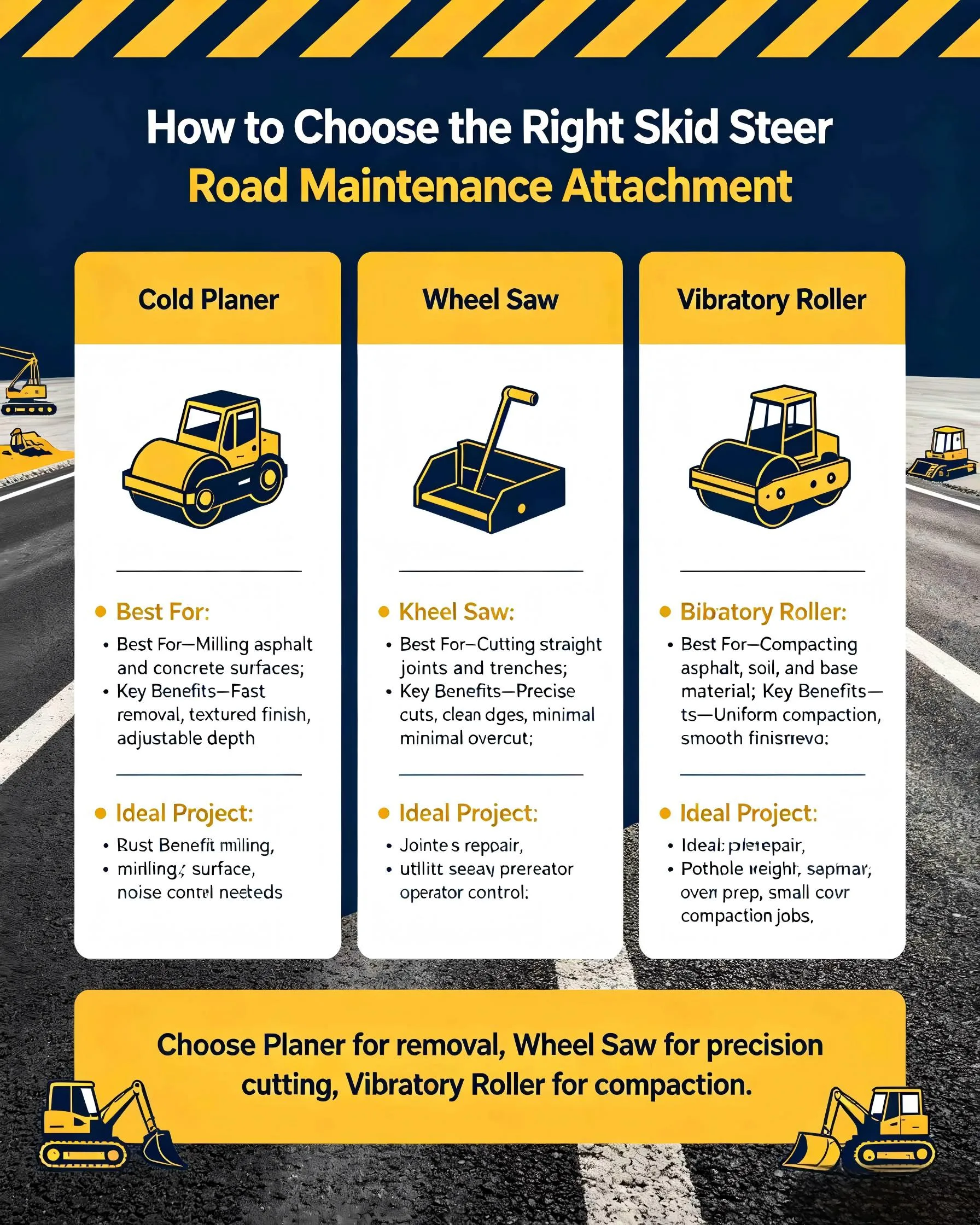
Road maintenance contractors rarely have the luxury of using one machine for every pavement task. Asphalt repair, trench cutting, surface preparation, and compaction require different working principles, hydraulic systems, attachment configurations, and levels of machine power.
For contractors using skid steer loaders, choosing the right attachment can make a major difference to productivity. The wrong attachment may still physically connect to the machine, but it may not deliver the hydraulic flow, working depth, cutting width, or operating performance required for the job.
HCN Attachments Manufacture currently offers several attachments suited to road maintenance and municipal applications, including the 0206 Series Cold Planer, Wheel Saw, and 0205 Vibratory Roller. These attachments are designed for different tasks, so they should not be treated as interchangeable tools.
This guide explains how the three attachment types work, where each one fits into a road-maintenance workflow, what technical specifications should be checked before purchase, and how contractors can select the right solution for their machines and applications.
Cold Planer, Wheel Saw, or Vibratory Roller: Which One Do You Need?
The simplest way to start is to define the actual job.
| Road maintenance task | Most suitable attachment | Why |
|---|---|---|
| Remove damaged asphalt or concrete surface | Cold Planer | Designed for milling and surface removal |
| Repair potholes and frost heave areas | Cold Planer | Provides controlled pavement milling before resurfacing |
| Cut pavement for narrow trenches | Wheel Saw | Designed for controlled trench cutting |
| Cut asphalt, frozen ground, or hard soil | Wheel Saw | Carbide-tipped cutting wheel handles demanding materials |
| Compact soil, gravel or asphalt | Vibratory Roller | Uses hydraulic vibration to compact the surface |
| Prepare a pavement area before resurfacing | Cold Planer | Removes deteriorated or uneven material |
| Compact a repaired or prepared surface | Vibratory Roller | Provides controlled compaction after material placement |
The important point is that these attachments solve different problems. A cold planer removes pavement. A wheel saw creates a controlled trench or cut. A vibratory roller compacts material.
That distinction should be the starting point for equipment selection.
1. When Should You Choose a Skid Steer Cold Planer?
A cold planer is the better choice when the main requirement is removing or correcting an existing pavement surface.
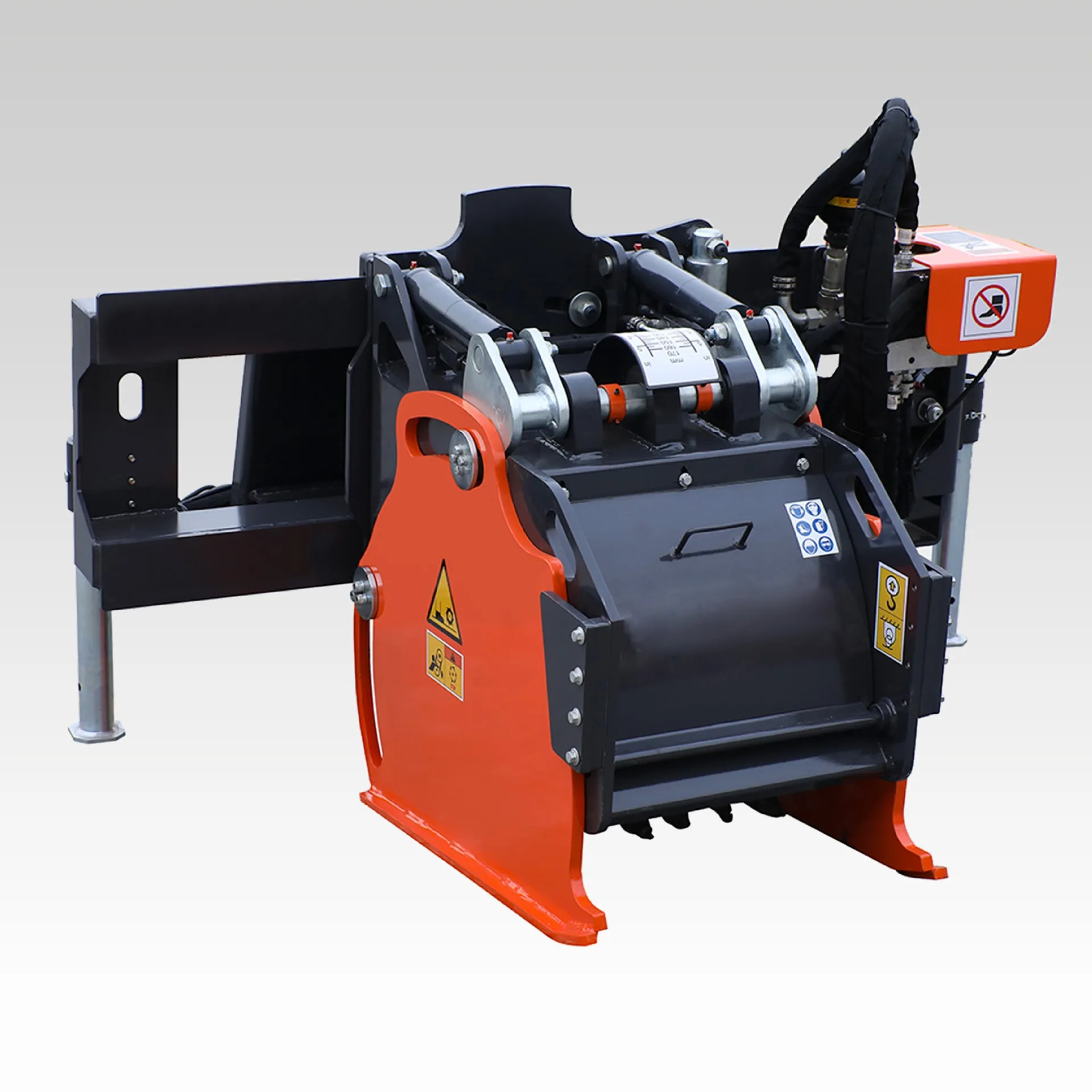
HCN's 0206 Series Cold Planer is intended for applications including asphalt and concrete repair, pothole and frost-heave repair, curb cutting, pavement texturing, traffic-lane stripe removal, and roadway work around manholes. HCN also describes the attachment as suitable for road repair, bridge-deck repair, landscaping, municipal, shopping-center, and utility applications.
What does a cold planer actually do?
Instead of removing the entire pavement structure, a cold planer uses a rotating cutting drum to mill the required section of asphalt or concrete.
This makes it particularly useful when a contractor needs to:
remove deteriorated pavement;
correct localized surface defects;
prepare an area before resurfacing;
cut pavement close to curbs or other obstacles;
remove road markings;
repair pavement around manholes;
perform smaller milling jobs where a dedicated milling machine may be impractical.
The HCN design includes hydraulic side-shift and depth-control features intended to improve positioning and cutting control. The product information also identifies optional water-tank and spray-system configurations.
HCN 0206 Series: important model differences
One of the most important purchasing mistakes is treating every cold planer model as if it has the same hydraulic requirement.
HCN currently lists the following specifications for its 0206 Series:
| Model | Working Width | Working Depth | Hydraulic Flow | Pressure | Weight |
|---|---|---|---|---|---|
| 020612 | 300 mm | 150 mm | 120–130 L/min | 21 MPa | 580 kg |
| 020618 | 450 mm | 150 mm | 130–140 L/min | 21 MPa | 887 kg |
| 020620 | 500 mm | 150 mm | 130–140 L/min | 21 MPa | 980 kg |
These figures come directly from HCN's current 0206 Series product information.
HCN also lists high-flow configurations including the 020618I and 020640. The 020618I has a 450 mm working width, 170 mm working depth, and a hydraulic-flow requirement of 120–140 L/min, while the 020640 has a 1,000 mm working width, 130 mm working depth, and a flow range of 120–200 L/min.
This is why buyers should always identify the exact attachment model before checking compatibility with a skid steer.
2. When Is a Wheel Saw the Better Choice?
A wheel saw is fundamentally different from a cold planer.
If the job requires a narrow, controlled trench or pavement cut, a wheel saw may be more appropriate than milling a wider surface area.
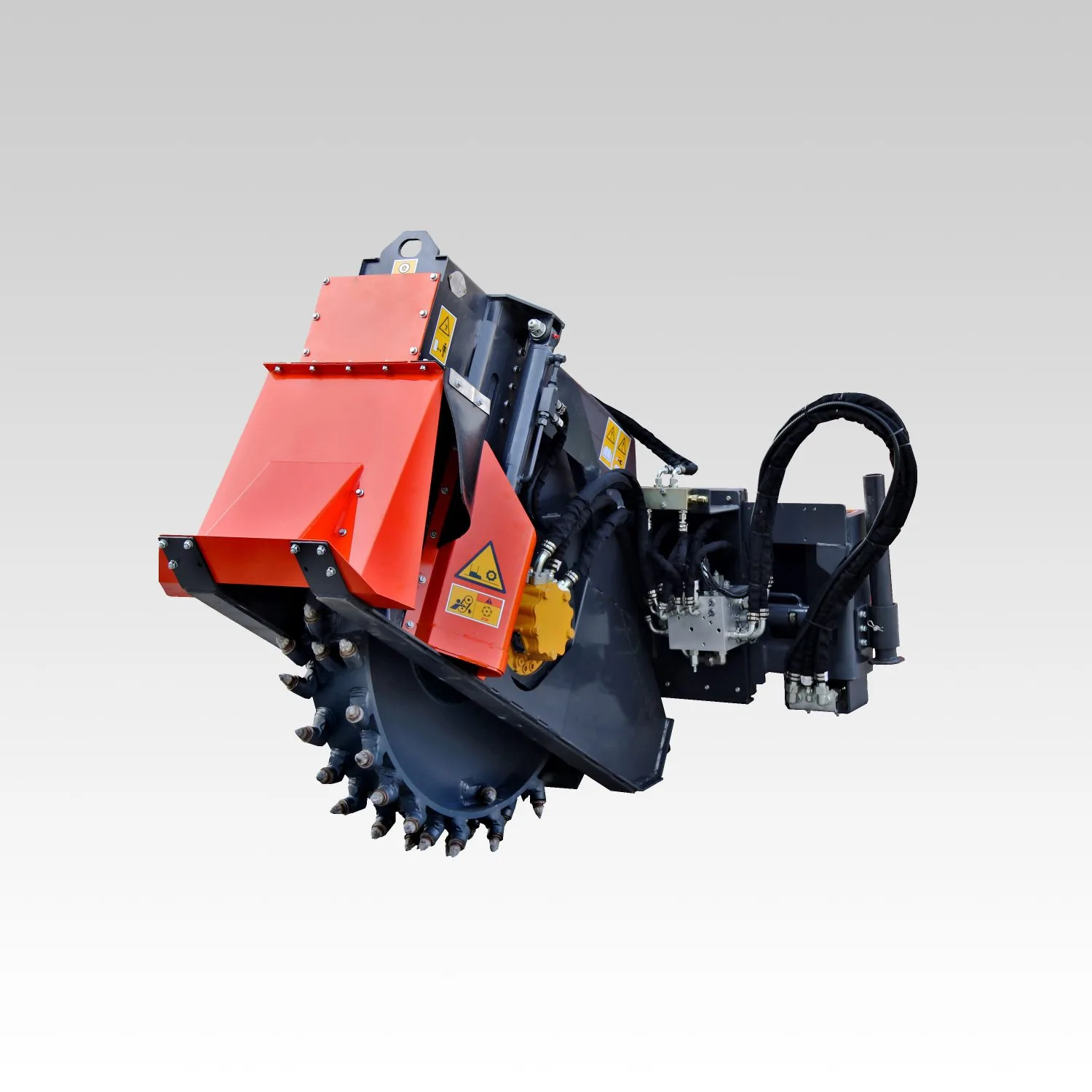
HCN describes its Wheel Saw as a high-flow skid steer attachment for cutting asphalt, frozen ground, and hard soils containing gravel. The product is specifically positioned for road maintenance and municipal construction, including applications involving pavement repair and utility-related trenching.
Why use a wheel saw instead of a breaker?
A hydraulic breaker attacks material through repeated impact. A wheel saw uses a rotating carbide-tipped wheel to make a controlled cut.
For applications where the contractor needs a defined trench width and depth, controlled cutting can be more appropriate than breaking a larger surrounding area.
HCN's Wheel Saw includes:
hydraulic depth control;
hydraulic side-shift;
a hydraulically operated trench-cleaning device;
spoil deflector plates;
an optional guide bar.
The side-shift allows the cutting wheel to be positioned away from the center of the machine, which is useful when working near curbs, walls, or other obstructions.
Wheel Saw model selection
HCN currently lists four Wheel Saw configurations:
| Model | Trenching Width | Trenching Depth | Weight | Hydraulic Flow |
|---|---|---|---|---|
| 030508I | 30 mm | 350 mm | 400 kg | 40–80 L/min |
| 030512I | 50 mm | 350–450 mm | 600 kg | 60–120 L/min |
| 030512IA | 80 mm | 450–600 mm | 700 kg | 60–120 L/min |
| 030516I | 100 mm | 450–600 mm | 1,100 kg | 90–150 L/min |
HCN specifies 21 MPa working pressure for the listed models. The product page also identifies the higher-flow versions as suitable for high-hydraulic-flow skid steer loaders.
The model choice should therefore be based on the required trench width, trench depth, machine hydraulic flow, and application, rather than simply choosing the largest available attachment.
3. When Does a Vibratory Roller Make More Sense?
A vibratory roller performs a different job again: compaction.
Once soil, aggregate, asphalt, or another suitable material has been placed or reshaped, the surface must often be compacted to achieve the required density and stability.
HCN's 0205 Vibratory Roller is positioned for contractors, rental fleets, landscaping operations, roadways, walkways, bike paths, bridges, golf courses, and parking lots.
The attachment uses a hydraulically powered exciter system. HCN also describes isolated drums, minimized exciter-shaft deflection, lower operating temperatures, and an integral knockdown blade. Smooth and pad-foot configurations are listed.
HCN 0205 Vibratory Roller specifications
| Model | Length | Weight | Dynamic Force | Hydraulic Flow | Pressure |
|---|---|---|---|---|---|
| 020560 | 1,760 mm | 890 kg | 31 kN @ 60 | 60–70 L/min | 20 MPa |
| 020572 | 2,060 mm | 955 kg | 37 kN @ 60 | 60–70 L/min | 20 MPa |
Both models are listed as suitable for skid loaders and small wheel loaders.
For a contractor repairing a road, the vibratory roller is not a substitute for a cold planer. Instead, it can become part of the next stage of the workflow after the pavement or underlying material has been prepared and new material has been placed.
4. Cold Planer vs. Wheel Saw vs. Vibratory Roller
A practical comparison looks like this:
| Factor | Cold Planer | Wheel Saw | Vibratory Roller |
|---|---|---|---|
| Primary function | Pavement milling | Narrow trench cutting | Compaction |
| Main materials | Asphalt and concrete | Asphalt, frozen ground, hard soil with gravel | Soil, gravel, asphalt and other compactable materials |
| Typical road application | Surface repair and preparation | Utility/pavement trenching | Surface compaction |
| Hydraulic demand | High to very high, depending on model | Moderate to high, depending on model | 60–70 L/min |
| Depth control | Yes | Yes | Not a cutting-depth function |
| Side-shift | Available | Standard | Not the primary function |
| Best purchasing criterion | Working width + depth + hydraulic flow | Trench width + depth + hydraulic flow | Compaction requirement + hydraulic flow |
The key lesson is simple:
Choose the attachment according to the physical operation, not simply according to the machine you already own.
5. Hydraulic Flow Is a Selection Criterion — Not Just a Specification
One of the most common attachment-purchasing mistakes is checking only whether an attachment physically fits the loader.
A universal quick-attach connection does not automatically mean that the machine has the hydraulic capacity required by the attachment.
HCN's own product range demonstrates why this matters.
For example:
The 0205 Vibratory Roller requires 60–70 L/min.
The 0206 standard cold planer models require approximately 120–140 L/min.
The high-flow 020640 Cold Planer is listed at 120–200 L/min.
The Wheel Saw models range from 40–80 L/min to 90–150 L/min.
A skid steer with insufficient hydraulic flow may not deliver the intended attachment performance.
At the same time, buyers should not assume that a higher-flow machine is automatically the correct choice. The attachment's specified operating range, pressure, motor configuration, and machine compatibility all need to be considered together.
A practical hydraulic compatibility check
Before ordering, procurement teams should collect:
Skid steer make and model
Auxiliary hydraulic flow
Auxiliary hydraulic pressure
Standard-flow or high-flow configuration
Quick-attach/mounting interface
Electrical requirements, if applicable
Available case-drain connection, where required
Attachment model and exact configuration
Required working width and depth
Operating weight and machine lifting capacity
This information should be checked against the specific HCN model, rather than against a general product category.
6. Machine Weight and Lifting Capacity Also Matter
Hydraulic compatibility is only one part of the selection process.
The attachment must also be appropriate for the loader's physical capacity.
Consider the difference between the HCN cold planer models: the standard 020612 is listed at 580 kg, while the 020620 is listed at 980 kg. The high-flow 020640 is listed at 1,150 kg.
Similarly, HCN lists the Wheel Saw from 400 kg to 1,100 kg depending on model.
For procurement teams, this means that “will it connect?” is not enough.
The correct question is:
Can the host machine safely carry, hydraulically power, and operate the selected attachment under the intended working conditions?
The loader's rated operating capacity, tipping characteristics, hydraulic system, auxiliary circuit, and manufacturer recommendations should all be reviewed before purchase.
7. Match the Attachment to the Road-Maintenance Workflow
For many contractors, the best answer is not choosing one attachment. It is choosing a combination of attachments that covers the complete workflow.
Example: pavement rehabilitation
A contractor may need to:
Step 1 — Remove damaged pavement
Use an appropriate HCN 0206 Series Cold Planer to mill deteriorated asphalt or concrete.
Step 2 — Perform localized cutting
Where utility access or trench work is required, an HCN Wheel Saw can provide a more controlled pavement cut.
Step 3 — Place new material
After the required base or pavement material has been installed, the work area needs to be prepared for compaction.
Step 4 — Compact the surface
An HCN 0205 Vibratory Roller can be used for compaction applications suited to the attachment and job conditions.
This approach is particularly relevant to contractors and municipal operators who want to use one skid steer platform across multiple road-maintenance tasks.
8. What Should Contractors Check Before Buying?
Before requesting a quotation, prepare a technical checklist rather than simply asking for “a road attachment.”
Host machine
Make and model
Operating weight
Rated operating capacity
Auxiliary hydraulic flow
Auxiliary hydraulic pressure
Standard or high-flow hydraulics
Electrical voltage
Quick-attach configuration
Job requirements
Asphalt, concrete, soil, gravel, or mixed material
Required cutting or working width
Required cutting depth
Required trench width
Required trench depth
Compaction application
Working environment
Frequency of attachment use
Attachment requirements
Exact HCN model
Operating weight
Hydraulic flow range
Working pressure
Working dimensions
Optional equipment
Required mounting interface
Replacement wear components
Transportation dimensions
This information allows the manufacturer or dealer to recommend the correct configuration instead of making a selection based only on attachment name.
9. Common Buying Mistakes to Avoid
Mistake 1: Choosing by attachment width alone
A wider attachment is not necessarily more productive if the machine cannot supply the required hydraulic power or safely handle the attachment.
Mistake 2: Treating all cold planers as equivalent
HCN's own 0206 range includes different working widths, depths, weights, and hydraulic requirements.
Mistake 3: Confusing cutting with milling
A wheel saw and cold planer both work on pavement, but they perform fundamentally different operations.
A wheel saw creates a controlled trench. A cold planer removes a defined area of pavement surface.
Mistake 4: Ignoring machine stability
A technically compatible hydraulic circuit does not automatically mean that the machine has the appropriate lifting capacity or operating stability.
Mistake 5: Buying before confirming the exact configuration
HCN lists multiple models within several attachment families. Buyers should identify the exact model and verify the specification before placing an order.
10. How to Choose the Right Attachment in 60 Seconds
Use this decision process:
Do you need to remove pavement?
→ Choose a Cold Planer.
Do you need to make a narrow, controlled pavement or soil trench?
→ Consider a Wheel Saw.
Do you need to compact soil, gravel, asphalt, or another suitable surface?
→ Consider a Vibratory Roller.
Then check:
Machine hydraulic flow → working pressure → attachment weight → working width/depth → mounting → application.
If any of these points is uncertain, do not select a model based on a generic flow range or another machine's specification.
Frequently Asked Questions
1. Can the same skid steer use a cold planer and a vibratory roller?
Potentially, yes, but compatibility must be checked for each attachment separately. HCN lists different hydraulic requirements and operating weights for its attachments, so the machine should be checked against the exact model.
2. Is a cold planer the same as a wheel saw?
No. A cold planer is primarily used for milling and removing pavement surfaces, while a wheel saw is designed to make controlled trench cuts. HCN's Wheel Saw also includes hydraulic depth control and side-shift for positioning the cutting wheel.
3. What hydraulic flow does an HCN cold planer require?
It depends on the model. HCN lists 120–130 L/min for the 020612, 130–140 L/min for the 020618 and 020620, and different ranges for its high-flow configurations.
4. What hydraulic flow does the HCN Vibratory Roller require?
The 020560 and 020572 models are both listed with a working flow of 60–70 L/min and working pressure of 20 MPa.
5. Which HCN attachment is better for utility trenching?
A Wheel Saw is specifically designed for controlled trench cutting and is positioned by HCN for road maintenance and municipal construction applications. The correct model depends on the required trench width, depth, hydraulic flow, and machine.
6. Can a cold planer cut both asphalt and concrete?
HCN describes its 0206 Series Cold Planer as suitable for asphalt and concrete applications. The product information also lists optional bit configurations for asphalt and cement/concrete applications.
7. How do I choose between different HCN cold planer models?
Start with the required working width and depth, then verify hydraulic flow, operating weight, machine capacity, and application. HCN's current 0206 specifications show meaningful differences between models, so the model number should always be confirmed before purchasing.
8. What information should I send HCN for an attachment quotation?
Provide your machine make and model, hydraulic flow and pressure, standard/high-flow configuration, intended application, required working width/depth, quantity, and any relevant mounting or electrical requirements. HCN's product pages explicitly ask buyers to provide the machine model and quantity for an accurate quotation.
Conclusion
Choosing a road-maintenance attachment should begin with the job, not the product catalog.
If the task is pavement removal or surface preparation, a cold planer is the logical starting point. If the task is controlled trench cutting, a wheel saw may be more appropriate. If the task is compaction, a vibratory roller addresses a different stage of the operation.
The next step is matching the selected attachment to the host machine's hydraulic flow, operating pressure, physical capacity, mounting system, and the exact working requirements.
HCN's current product range includes multiple configurations within these attachment families, so contractors, equipment dealers, rental companies, municipalities, and fleet managers should confirm the exact model before ordering rather than relying on a generic attachment category.
For a project-specific recommendation, provide the host machine model, hydraulic flow, hydraulic pressure, intended application, required working width/depth, and quantity so the appropriate HCN configuration can be evaluated.
 +86 185 5285 3111
 +86 185 5285 3111
 nancy@hcn-tech.com
